Backstage Index v2
Your Results
This isn't about how good you are. It's about where each of the four parts stands today: whether things begin, get finished, land with people, and happen again.
Every score is a percentage from 0 to 100. Higher means further along. There's no opposite end to land on, and no type to be sorted into.
You get a composite level for the whole index, a facet level for each of the four parts, a chart of them together, and a next move — the facet with the most room to grow.
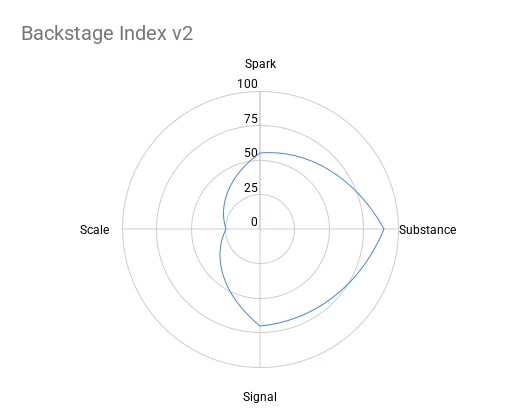
Composite level
One percentage across every statement.
🎬 Backstage Ready 88–100
The work behind the work holds up on its own: things begin, get finished, land with people, and happen again. The gains now come from raising one part deliberately, not tightening everything.
🎛 Tight Production 78–87
Most of this runs without drama, and you can probably feel which part is carrying the others. What's left is narrow and specific.
🎤 Show on Its Feet 68–77
Things start, get finished, and reach people fairly reliably. The unevenness now is between the parts rather than inside any one of them.
🎹 Finding the Rhythm 55–67
Parts of your work are starting to feel familiar rather than improvised. What's missing is being able to count on it in a week that goes badly.
📻 First Run 0–54
Right now most of what you do happens once, in the moment, and lives mainly in your head. That's where everyone starts, and it's where one change makes the biggest difference.
Facet level
Read as a sentence: your Signal is Established.
Advanced 88–100
It's built in, and other people count on you for it.
Mature 75–87
You do it on purpose, before anything asks.
Established 63–74
You do it reliably, when the situation calls for it.
Developing 50–62
You notice when it's missing. Something else usually supplies it.
Emerging 0–49
This part hasn't started yet. When it happens, it's by accident.
Why Two Ladders
Averaging every statement cancels variation that a single facet keeps, so the two scales have to be spaced differently. Run one shared scale over both and it crowds people into the middle levels and never uses the bottom one.
The words differ on purpose too. When both ladders shared a vocabulary, the composite stopped reading as a summary and started reading as a sixth facet.
The Four Facets
- Spark: starting before the path is clear.
- Substance: finishing what gets started, including the parts that stopped being interesting.
- Signal: making the work understood by people outside it.
- Scale: making something work a second time without redoing the thinking.
What a Facet Reading Sounds Like
Every facet gets its own wording at every level — never a generic line reused across four. Same facet, two ends of the same climb:
Substance · Emerging
Ideas arrive faster than they finish, so you own mostly beginnings. Unfinished work blocks what comes next. This week: finish your smallest unfinished thing, all the way.
Substance · Advanced
You finish everything, which is the problem. Some work deserves abandoning. This week: end one project you're finishing out of stubbornness.
Nobody Is At The Top Of Every Facet.
That's why four of them are scored separately. A single number tells you how far along you are; four tell you where, and which one to move next.
Pick the part that would change the most if it climbed, and start there. One week of deliberate work on your lowest facet moves it further than a month of general effort spread across all four.
"I ended the process with a usable, impressive, effective tool. All the parts just snap together like magic."
— Tiffany Markman
Brand Voice Expert
"This took my idea from paper to product in a week. It helped me build something I can actually sell — that's a game changer."
— Tim Wagner
Speaker & Performance Coach
"This is going to be an absolute game changer in my business. If you get a chance to join the cohort, don't even hesitate. Do it."
— Chantelle Botha
Identity Architect